Part 1
I have been thinking a lot about grace recently.
Grace has a lot to do with the issues I had with the mission theology of Pura Vida Missions when I travelled to Costa Rica. I have kind of been thinking that I need to explain myself a little bit. I complained a lot about poor mission theology in some of my most recent posts, and then I never said why I think it was poor theology, or what good theology looks like. The other week my friend Chris asked me, "Becca, why was it so bad? What exactly was it?" So, I am going to tell you what I think. Now, I know who some of my readers are, and I know that not all of you will be comfortable with my take on things. Please understand that this is an expression of who I am deep in my theological being more than it is a condemnation of what you may believe. I have to be true to myself--in the words of Martin Luther, "Here I stand. I can not do otherwise. God help me, Amen!"
I think I need to start this blog with a story from my past. I grew up in Huntsville, Alabama, in the middle of the Bible Belt. Alabama tends to be very religiously conservative. They are also almost always a "red state" during presidential elections. Most of the people who I went to high school with were from the Southern Baptist tradition. Those who weren't were generally non-denominational, evangelical, or Pentecostal Christians (this is based on my observation and personal experience, not on data I researched). As a more liberal Lutheran person, I was in the minority religiously, and I therefore had to think hard about what I believed at a very early stage in my life. I often saw the incongruities between my faith and the way I practiced it and the religious habits and beliefs of the people around me.
One of the things that made me very uncomfortable as a Lutheran growing up in Alabama (I always used to joke that there were only 3 Lutherans in all of Alabama, and they were all in my family) were the questions. I remember one of my friends asking me once, "Are you Christian?" I told her yes--I am a Lutheran. "But, are you CHRISTIAN?" she asked. Another time someone asked me if I had been "saved," i.e., if I had decided to give Jesus my heart and asked him to be my personal Lord and Savior. Lutherans just don't talk like that! So, I gave what I still believe to be a very correct answer--I said that I had been baptized as a baby and that Jesus died and rose for me. I said that God loves me and all of His children, and His grace has set me free from the bondage of sin and death. I am proud that as a young person I was able to articulate my beliefs and stand up for my faith. I owe that in no small part to my parents, Sunday School teachers, youth leaders, and pastor.
My experiences as a youth growing up in Alabama led me to develop a strong mission theology while I was still in high school. The questions people asked about my faith made me uncomfortable mainly because I felt like they were trying to evangelize me. ME!? A good Christian girl? I knew that some people felt that I needed to convert from my sinful Lutheran ways and join the Southern religious status-quo. I found that offensive. I still struggle with prejudices against conservative and evangelical Christians because I know how horrible their evangelism tactics made me feel at the time. The basic sense of their argument (in my eyes) was that God couldn't save me unless I conformed to their belief system.
When I was a junior in high school I had an amazing, transforming, spiritual experience at the ELCA (Evangelical Lutheran Church in America) National Youth Gathering. If I had to pinpoint a moment in my life when God finally got to me and transformed me, that would be it. Following that experience, I really began feeling the call to ministry. More specifically, I began feeling the call to MISSION.
My view of mission at that time was what I had been shown by the Christians around me--something that made me feel icky, as if God couldn't grant me salvation unless I was like them, "born again," "saved," or whatever. The idea that I could be called to mission made me feel, well, icky. I didn't want to make others feel as disrespected and unloved as others' Christian evangelism tactics had made ME feel. No one had ever bothered to ask me what I believed. No one had bothered to find out WHO I was or WHAT I was all about. They didn't care much about who I was at all. They just wanted me on their side. They wanted me on the "right" side (both figuratively and politically).
I recently met a man from Africa who married a Pennsylvania Dutch girl from Lancaster County. My husband Pierre and I met them because of the reason we often meet people like them--we look like them and have a demographic similar to theirs. White American woman marries black African man and vice versa. We had dinner together. I will never forget the first two things that man wanted to know about me when we met for the very first time. He knew I worked in the church. And yet, what did he want to know? 1. Was I "born again"? and 2. What did I think about "gay people"? Seriously? That's it?
Bad mission theology is bad specifically because it does not seek to discover others' stories. It does not respect who they are or seek to know more about them. Bad mission theology only has ONE goal: to "save" poor, lost souls. Bad mission theology's general definition of poor, lost souls is anybody who does not believe and practice the same thing you do. Bad mission theology does not take into account that it is GOD who does the saving, and not over-zealous Christians.
The other thing that really frustrates me about bad mission theology is that it assumes that God is somehow limited in God's power to save humanity. It puts God in a box. It says, "Hey, look. If you are Lutheran, gay, Muslim, liberal, an adulterer, thief, or a hippie (or something else we don't like), God just can't save you. Sorry. But, there is hope for you--become like us, and God will love you like God loves us." Bad mission theology claims that the only truth that exists is the truth these people are perpetuating.
Now, I'm sorry, but exactly what kind of God do these people believe in, anyways? Didn't Jesus come to save HUMANITY? Didn't Jesus eat with prostitutes and tax collectors? Aren't we all as sinful as that Lutheran liberal gay hippie who is cheating on his wife sitting next to us on the bus? Don't say you're not! I know I am, and you are, too. The good news is, God loves us ALL anyways!
That's what grace is all about. God CAN and DOES meet us where we are, love us as we are, and transform us into the people God calls us to be. GOOD mission theology understands that, respects that, and yet also challenges us to become more closely aligned with who God wants us to be.
In Part 2 I promise I will stop ranting and get to the heart of who we are as Christians--despite my early aversion to the call, I now fully believe that ALL Christians are called to mission. I want to talk more about good mission theology and the work that all Christians are called to do.
Thursday, October 18, 2007


Tuesday, September 25, 2007
Diaconal Ministry
What the HECK is it?
As I continue preparations for my consecration on November 4, I am getting a lot of questions about Diaconal Ministry. People receive my consecration announcements, and they inevitably have 2 questions:
As I continue preparations for my consecration on November 4, I am getting a lot of questions about Diaconal Ministry. People receive my consecration announcements, and they inevitably have 2 questions:
- What's a Diaconal Minister?
- What's a Consecration?
So, I am off to "God's Country" for the next two weeks (My grandfather was from Minnesota, and he always swore it was "God's Country" - that and "The Land of the Sky Blue Waters"), and I thought it might be nice to answer those questions before I leave.
NOTE: This is not the "controversial" post I have been working on; it's just a little something to tide you over until I get a chance to write again.
First of all: If you are reading this post, then you are welcome to attend my consecration. So, before I tell you what a consecration is, let me officially invite you to one! Here is the invitation:
Now the word of the Lord came to me saying,
“Before I formed you in the womb I knew you,
and before you were born I consecrated you;
I appointed you a prophet to the nations.”
--Jeremiah 1:4-5
You are cordially invited to the Rite of Consecration of
Rebecca Hanson Kolowé
to the Ministry of Word and Service as a Diaconal Minister in the
Evangelical Lutheran Church of America
November 4, 2007 at 4:00 P.M.
Trinity Evangelical Lutheran Church
1000 West Main Street, Lansdale, Pennsylvania 19446
(Corner of Routes 63 and 363)
Reception immediately following
Rostered leaders are invited to vest and process. The color of the day is white.
Please come! I hope to see you there!
***
Now, to answer those two questions! Here is an excerpt of an article that was originally published in Trinity's Lansdale Lutheran. It should answer all of your questions about Diaconal Ministry, consecrations, and perhaps some other things! I wrote it, and have made some changes here to better suit my blog.
DIACONAL MINISTRY
Rebecca Kolowé, Trinity's Pastoral Assistant in charge of adult and young adult education, is about to become a consecrated Diaconal Minister.
What is Diaconal Ministry?
Diaconal Ministry is a ministry of Word and Service. One way to explain it is to compare the ministry of a Pastor with the ministry of a Diaconal Minister: Pastors are called to a ministry of Word and Sacrament. This means that Pastors preach the Word and administer the sacraments (Holy Communion and Baptism). Diaconal Ministers are called to a ministry of Word and Service. This means that Diaconal Ministers preach the Word and focus on serving others.
What is a Diaconal Minister?
A Diaconal Minister is someone who is consecrated (or “set apart”) by the church to perform ministries of Word and Service.
What is a consecration?
A consecration is a rite of the church in which Diaconal Ministers are set apart for their particular ministry. It is very similar to the way a pastor is ordained.
What do you mean by a ministry of service?
The church says that Diaconal Ministers are called into a ministry of service at the place where the church meets the world. This means that Diaconal Ministers are called to serve the poor, afflicted, unlovely, and anyone who lives at the fringes between church and world.
If your ministry is a ministry of service outside of the church, then what are you doing working in a congregation?
The official website of the ELCA (Evangelical Lutheran Church in America) Diaconal Ministry community (Please visit the ELCA Diaconal Ministry Community online at www.elca.org/diaconalministry) states, “Diaconal Ministers work to seek wholeness in the world and to help the people of God to live out the Gospel… [Diaconal Ministers work towards] equipping others for healing and justice in the world.” One aspect of service to others equipping the people of God, the people in the church, to be in service to others.
What kinds of jobs do Diaconal Ministers do?
Diaconal Ministers serve in a lot of different areas. Some of them, like me, work in congregations, encouraging and equipping others to serve. Other Diaconal Ministers may work for social service organizations, as chaplains, in campus or youth ministry, as counselors or spiritual directors, or in other areas.
How do you get to be a Diaconal Minister?
Diaconal Ministers must attend an ELCA seminary and complete the required degrees and requirements. Candidates for Diaconal Ministry also undergo a candidacy and call process before they are consecrated to service.
What is the difference between a deacon and a Diaconal Minister?
Diakonia is a Greek word taken out of the New Testament that means “service.” A deacon, therefore is a servant. Diaconal Ministers and deacons are both servants and are both the same thing. “Diaconal Minister” is the term that the ELCA has decided to use to designate its deacons.
As a Christian, I help serve others, too. What's the difference between me and a Diaconal Minister?
In many ways, we are ALL called to be deacons, and all of the various ways we minister to each other are important. All Christians should be in service to others. Jesus called us all to be deacons when he said, “You shall love the Lord your God with all your heart, and with all your soul, and with all your strength, and with all your mind; and your neighbor as yourself” (Luke 10:27). The difference between an ELCA Diaconal Minister and other lay people is that a Diaconal Minister has attended seminary, has gone through the church-wide call process, and has been consecrated (“set aside”) by God and the church to a specific ministry. It is similar to the way a Pastor is educated, called, and ordained to a specific ministry.
Aren’t you a deaconess?
I am not a deaconess. In the ELCA, deaconesses are women who are a part of a deaconess community. Although our call to service is very similar, only women who are a part of the deaconess community are to be called deaconesses. I am a Diaconal Minister, and you may call me a deacon.
Why have I never heard about Diaconal Ministers before?
Deacons have existed in the wider church for hundreds of years. However, the term “Diaconal Minister” and its recognition as a consecrated ministry of the ELCA only became official in 1993.
Why haven’t you told us earlier about you being a Diaconal Minister?
I am actually not a Diaconal Minister yet. I graduated from seminary in 2004, but was still working to complete the candidacy and call process when I began working at Trinity. I finished those final requirements in April. I will officially become a Diaconal Minister on November 4, 2007, when Bishop Burkat consecrates me as a Diaconal Minister. That service will be here at Trinity, and I would love for you to come and be a part of that special day!
Saturday, September 22, 2007
Slacker
Ok, I know I have been a bit remiss in my blogging duties recently. The truth is, with all the fall programming starting up at church, I have been swamped! Plus, Pierre and I are planning a 2-week vacation at the beginning of October, so I have to get all my work done before then!
In reality, I do have a blog I have been working on, but I am a little nervous about posting it. I think some people I know might not like it, and I am not sure if I am ready to deal with that. I know that some of you who have known me for a long time might think this is a little out of character for me. But, this particular blog is about an issue that is very close to my heart, and that makes it harder to put it all out there on the line for the whole world to see and critique.
How's that for a teaser?
Anyways, I promise to get something good posted as soon as I can! In the meantime, enjoy the change of seasons, the cooler weather, and all the wonderful things God has given you!
Sunday, September 2, 2007
Pura Vida: "Pure Life" in Costa Rica
Part 4
(Scroll down to read parts 1-3)
This is my last blog about my trip to Costa Rica with the synod at the beginning of August. I have been thinking a lot about Costa Rica the last few days. When I came home I went right back to work and really didn't get much time to process the trip. Now that it is the holiday weekend and I have had some time to myself away from the busy-ness of work, some things are clearer to me than they were immediately following my return.
First of all, I should make it clear that I had a really good time. I definitely had issues with the mission theology and teaching methods of Pura Vida Missions, but that doesn't take away from the fact that we were there to love and serve Costa Rican children, and we did that successfully and with great passion. In many ways the theology of Pura Vida Missions doesn't even matter, because those children (and our youth) had a great time and learned a lot about God's love for them through our service. The Holy Spirit was there, and she was working! A wise missionary once said to me, "The Holy Spirit doesn't work because of us, the Holy Spirit works in spite of us." Even though I heartily disagree with the theology of evangelism that Pura Vida practices, that doesn't mean that the Holy Spirit was absent. God can do great things, even in the midst of us sometimes doing not-so-great things.
Secondly, I feel really blessed to have been able to be a part of the lives of such wonderful, interesting youth. The young people who went on this journey with me are all intelligent, interesting people with futures full of hope. Some of them really touched my life, and that makes me feel very blessed. It was neat to see these young people blossom as they discovered a culture different from their own. Some of them really came out of their shells--they were discovering new things about themselves, too! Others revealed that there are things in their lives that they are really struggling with right now. Throwing people who don't know each other together like that in a different cultural environment can lead to wonderful realizations about ourselves and each other.
In particular, today I am thinking a lot about Jenn, Holly, and Candice. Each of them had their own very personal experiences, struggles, and revelations on this trip, and each of them taught me something about myself. There are others, too, who I have not named. I hope that they all continue to grow into the fabulous, enlightened young adults they are becoming.
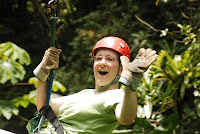
Probably the last thing that I need to say is something that I learned about myself toward the end of our time together in Costa Rica. I have always said during my travels around the world that I will always try anything once (except for fried termites--a girl has to draw the line somewhere!). Well, towards the end of our time in Costa Rica, that mantra was severely tested. On our last full day in Costa Rica we went out into the jungle to participate in a canopy safari (You can visit Canopy Safari's website here). For those of you who don't know what a canopy safari is, let me explain it to you. You are attached to a harness, and you literally hang in this harness from a carabiner that is attached to a cable suspended between trees, high up in the air (otherwise known as a zip-line). But, you are not just attached to the cable--you actually move through the air between the trees by "zipping" along this zip-line. It is cool in the fact that you get to see the canopy from within the canopy. It is NOT cool in the fact that you are flying through mid-air 150 feet up (or some such crazy height) with nothing holding you up except this cable, harness, and carabiner. Like this:
 And this:

I have to tell you, I was scared to death to do this! We were all told that we didn't have to do it, but that the entire group would be participating and that we would regret it and disappoint everyone else if we didn't do it. As a leader on this trip, I really felt like I had to. I was one of the people setting an example for the rest of the group. But, I really didn't want to, and I was scared! It even made me cry. However, one of the young people in my group, Holly, really encouraged me and I was able to overcome my fear and participate in this experience (but not without some swearing on my part). After having processed the day, I would probably even say that I had fun (something I was not willing to say immediately after the tour was over and I took off my harness and kissed the earth). I might even be willing to do it again someday. That is definitely growth for me.
My overall experience that day was awesome--I learned that I could do something I really thought I couldn't. I swear I thought I might die, but I came out OK in the end. It wasn't that bad and was actually kind of fun. And Holly really ministered to me and gave me the courage to do it. I wonder if she knows how important and powerful that was?
I also owe a lot to Big Al:

He seemed like a rough guy (he was telling jokes about some guy's "woody" on the way to the safari site) but really helped me be brave and didn't mess around because he knew I was scared. All in all, the staff at Canopy Safari was awesome. They took good care of us, and made sure we had a safe, positive, and fun experience.
The Canopy Safari was a good cap to an awesome week. I am proud of our youth for being such awesome young people--they did great work with the Costa Rican children, and ministered to me and to each other, too. I can only hope that I made a similar impression on them. During our time in Costa Rica, we all discovered more fully what it is like to live in God's Promise, as Children of God.

(Scroll down to read parts 1-3)

This is my last blog about my trip to Costa Rica with the synod at the beginning of August. I have been thinking a lot about Costa Rica the last few days. When I came home I went right back to work and really didn't get much time to process the trip. Now that it is the holiday weekend and I have had some time to myself away from the busy-ness of work, some things are clearer to me than they were immediately following my return.
First of all, I should make it clear that I had a really good time. I definitely had issues with the mission theology and teaching methods of Pura Vida Missions, but that doesn't take away from the fact that we were there to love and serve Costa Rican children, and we did that successfully and with great passion. In many ways the theology of Pura Vida Missions doesn't even matter, because those children (and our youth) had a great time and learned a lot about God's love for them through our service. The Holy Spirit was there, and she was working! A wise missionary once said to me, "The Holy Spirit doesn't work because of us, the Holy Spirit works in spite of us." Even though I heartily disagree with the theology of evangelism that Pura Vida practices, that doesn't mean that the Holy Spirit was absent. God can do great things, even in the midst of us sometimes doing not-so-great things.
Secondly, I feel really blessed to have been able to be a part of the lives of such wonderful, interesting youth. The young people who went on this journey with me are all intelligent, interesting people with futures full of hope. Some of them really touched my life, and that makes me feel very blessed. It was neat to see these young people blossom as they discovered a culture different from their own. Some of them really came out of their shells--they were discovering new things about themselves, too! Others revealed that there are things in their lives that they are really struggling with right now. Throwing people who don't know each other together like that in a different cultural environment can lead to wonderful realizations about ourselves and each other.
In particular, today I am thinking a lot about Jenn, Holly, and Candice. Each of them had their own very personal experiences, struggles, and revelations on this trip, and each of them taught me something about myself. There are others, too, who I have not named. I hope that they all continue to grow into the fabulous, enlightened young adults they are becoming.
Probably the last thing that I need to say is something that I learned about myself toward the end of our time together in Costa Rica. I have always said during my travels around the world that I will always try anything once (except for fried termites--a girl has to draw the line somewhere!). Well, towards the end of our time in Costa Rica, that mantra was severely tested. On our last full day in Costa Rica we went out into the jungle to participate in a canopy safari (You can visit Canopy Safari's website here). For those of you who don't know what a canopy safari is, let me explain it to you. You are attached to a harness, and you literally hang in this harness from a carabiner that is attached to a cable suspended between trees, high up in the air (otherwise known as a zip-line). But, you are not just attached to the cable--you actually move through the air between the trees by "zipping" along this zip-line. It is cool in the fact that you get to see the canopy from within the canopy. It is NOT cool in the fact that you are flying through mid-air 150 feet up (or some such crazy height) with nothing holding you up except this cable, harness, and carabiner. Like this:
 And this:

I have to tell you, I was scared to death to do this! We were all told that we didn't have to do it, but that the entire group would be participating and that we would regret it and disappoint everyone else if we didn't do it. As a leader on this trip, I really felt like I had to. I was one of the people setting an example for the rest of the group. But, I really didn't want to, and I was scared! It even made me cry. However, one of the young people in my group, Holly, really encouraged me and I was able to overcome my fear and participate in this experience (but not without some swearing on my part). After having processed the day, I would probably even say that I had fun (something I was not willing to say immediately after the tour was over and I took off my harness and kissed the earth). I might even be willing to do it again someday. That is definitely growth for me.
My overall experience that day was awesome--I learned that I could do something I really thought I couldn't. I swear I thought I might die, but I came out OK in the end. It wasn't that bad and was actually kind of fun. And Holly really ministered to me and gave me the courage to do it. I wonder if she knows how important and powerful that was?
I also owe a lot to Big Al:

He seemed like a rough guy (he was telling jokes about some guy's "woody" on the way to the safari site) but really helped me be brave and didn't mess around because he knew I was scared. All in all, the staff at Canopy Safari was awesome. They took good care of us, and made sure we had a safe, positive, and fun experience.
The Canopy Safari was a good cap to an awesome week. I am proud of our youth for being such awesome young people--they did great work with the Costa Rican children, and ministered to me and to each other, too. I can only hope that I made a similar impression on them. During our time in Costa Rica, we all discovered more fully what it is like to live in God's Promise, as Children of God.

Friday, August 24, 2007
Pura Vida: "Pure Life" in Costa Rica
Part 3
(Scroll down to read parts 1 & 2)

Morning
Thursday, August 9, 2007
There's this dog that lives next door to the mission that looks like the Budweiser dog. Brown and white with that flat face and pointy ears. He has his own dog house in the back corner of the yard and barks and wags his tail (mixed signals) when someone comes by.
Costa Rica is beautiful and tropical and lovely. The children are wide-eyed and eager to play, learn, and love. Our youth shared last night during debriefing how much the children have touched their hearts. The work is hard but fun and the mission of God and of God's church is so clearly happening here. I praise God that God is showing these youth what it means to be a Christian in mission in this world.
The other side of that for me (and for some of the youth and other adults who are alert) is the negative experience we have had with the staff. For me, a lot of it comes down to mission theology. Mission theology and Christian education are at the core of my personal identity, and this week I have felt trampled upon. There is a caution of care that seems to be lacking here. Why are these people really here? Some of our youth and adult leaders have said they think it could be for selfish reasons. Plus the fact that this is an American-run mission and that the Costa Ricans working here are the ones doing the grunt-work ("hired hands," almost) turns me off. The motivation and the model that I see being presented is very "us/them." An "Oh, let's pity these poor Costa Ricans" kind of mentality.
I am afraid of what this way of doing things is showing our youth. I hope they know better, or will at least process this week and eventually come to know better. I know that I and our other trip leaders have tried to be intentional in letting them know that there is another way to do mission--a way that is non-threatening, love-filled, and good. I really pray that God works in their lives to show them the true meaning of Christian living, service, and mission. I really pray that this week will positively affect their outlook and beliefs. I know some of them are struggling with some of these things already. I know that God is with all of them, and I pray that God works on their hearts for good.

Morning
Friday, August 10, 2007
Last night I stood in the rain at a public telephone outside a house store up the street and called my husband. I have been trying to reach him all week! It was good to hear his voice, but we didn't have much time to talk. It wasn't the place for serious conversation. It was mostly formalities, but it was still good to talk to him.
Today is the last day at the mission. At noon we will get on the bus and drive three hours to the Pacific Ocean. I am thankful to be able to leave this place and spend a few days relaxing and unwinding. It will be nice to sleep in a hotel, have nicer facilities, relax on the beach, go shopping, etc. We are also going on a canopy tour in the morning, which I am a little freaked out about but I hope will be really cool.
Yesterday I felt like the staff finally got us. This has been a rough week with them, but yesterday things finally seemed OK. Maybe they are as excited as we are to be coming to the end of their journey. We are their last group, and most of them will be returning to the U.S. this weekend.
I think last night was really hard for the youth. There was a lot of sharing and crying. It will be hard, and yet good, to go home. A lot of these young people are really struggling with a lot of things--not just about this experience, but about life. I hope they can leave this place with a different, helpful perspective.

Early Evening
Saturday, August 11, 2007
We travelled four hours by bus yesterday across Costa Rica to Manuel Antonio, a small beach resort town on the Pacific Ocean. It was interesting watching the countryside change from densely-populated Costa Rican mountain towns to miles of land filled with cows and grass where few people seemed to live, to mountainous coastal villages filled with resorts, condominiums, and Americans. In some ways, we could almost be in America in Manuel Antonio. Costa Ricans here are more like the hired help than the native population. In this part of Costa Rica, the U.S. Dollar and the white man rule.
It is still tropical and beautiful here. There is a sign on the bathroom wall warning us of a water shortage and reminding us that Costa Rica, in all its beauty, is still a Third World country. Is it? Things here are a lot better in a lot of ways than in Africa. I have been impressed by the many conveniences here--I have yet to have to pee in a hole in the ground! When I look around, I don't see Third World. I see people with many of the modern conveniences we have in America--cars, running water, electricity, good infrastructure. Costa Rica is somewhere between Africa and the U.S. in that regard. Maybe Second World?
Tourism is the biggest industry in Costa Rica, and in this part of the country it is definitely obvious. It is a shame that tourists (mostly Americans, I gather) are creating a new kind of "tourist colonialism" here. The dollar and American wants and needs seem to be taking over. At what cost? At whose expense? What is being lost? Is it really worth it? Does anybody other than me ever think about these things? What makes me the saddest is that most of the Americans (and other tourists) that come here don't seem to think about these things. They just want to spend their money and enjoy themselves, and they want the Costa Ricans to help them do it.
On the other hand, I am sure that it is tourist dollars that are making Costa Rica the well-developed nation that it is becoming. Is the loss worth the gain? Is that a fair trade-off?
Today we went on a canopy tour, which was really stressful for me! We basically "swung through the air with the greatest of ease" on zip-lines suspended between the trees high up in the canopy. Not exactly my cup of tea!

Subscribe to:
Posts (Atom)