It is with much fear and longing that I have been visiting my blog in the last few months. I come here and haunt it, needing to write, but not knowing what to say. And then I end up saying nothing. As someone who tends to bare all when I write (and speak), I have known these last few months that the things I am thinking about are not things that I could write down in a blog without raising some eyebrows. I also don't know what to say--when your feelings get so jumbled up inside that you can't even explain them, then how do you go about sharing them?
Six months ago, I wrote a blog called "Breaking Up and Breaking Out" about my difficulty with a church that struggles to affirm my gifts for ministry as a Child of God, much less in my role as Diaconal Minister. I came to understand that the only way I was going to be able to come to terms with God's call as deacon was to be willing to forsake everything to follow the call--even if it meant forsaking the church. I came right to the edge of that place. I stood at the precipice and looked over the edge. I was ready to jump. I knew I would always be a deacon. I knew that God had called me into God's service and had so many wonderful things in store for me as a part of our great love affair. I just didn't think the church was ready for me and what that call might mean. And I wasn't at all sure that I was ready to fight for it. God was calling me to serve and not fight, right? I didn't need the church in order to be able to serve. Maybe it was just better to leave.
And then, all of a sudden, perhaps because I was finally able to say I would leave, it became OK not to. Maybe I needed to be willing to walk away, forsaking all others--including even the church--for God to really be able to use me. There is Biblical precedent for that: "Then Jesus told his disciples, ‘If any want to become my followers, let them deny themselves and take up their cross and follow me. For those who want to save their life will lose it, and those who lose their life for my sake will find it.'" (Matthew 16:24-25).
One of the things that I have come to realize in these last few months is that the call is still the same. It is a call to service. And, the call to service, and actually living into that call as a member of the Body of Christ, is one of the most radical ways in which transformation occurs within us, and outside of us. I don't have to "fight." The Holy Spirit is blowing in this church, and in my life and in the lives of the people around me. The Holy Spirit is reforming the church and reforming me, in all the wonderful and scary ways that happens. All we have to do is be "in the flesh." We have to be real to those people around us. Loving them. Hurting for them and with them. Rejoicing with them. Being the face of Christ to each other. It does make me wonder if being "incarnate" will ever be anything less than revolutionary.
One of my friends recently asked me how we go about changing the injustices in the world. He was particularly referencing racism, but it could have been anything. I told him the only answer I know--which is to lead by example. Revolution happens when instead of fighting, we serve. Revolution happens because through service, we fight for something worthwhile.
And there is more. So, so much more. But, I think I'll hold on to that a while longer, until I can get it sorted out enough to write it down.
Showing posts with label Justice. Show all posts
Showing posts with label Justice. Show all posts
Tuesday, September 8, 2009


Friday, August 1, 2008
People Who Get It

Can I just say something?
I spent last week with an amazing bunch of young adults. Four of them were from my congregation, and six of them were from a Methodist church in Hamilton, New Jersey. We spent the week in Wyoming County, West Virginia, serving with Appalachia Service Project (ASP). We didn't all go together. Heck, we didn't even know each other before last week! But when we were placed at the same work site together, relationships were formed and magic happened.
I just want to say how easy it is sometimes to get frustrated with people who don't get it. Many Christians don't understand what it means to be Christian. They don't understand that the call to Christian life is the call to service. Day after day I constantly wonder how I am supposed to empower people to live out their Christian call to service when they think service is synonymous with "serve us."
I was really proud to be a part of our little band of four who embarked on a journey to serve in West Virginia last week. And, I was really honored to get to know the six from New Jersey. I felt like I had come home... I was really in my element, in service, hands (and just about everything else) dirty. And, I was surrounded by people who get it. Granted, we all had our moments of insanity. But I know that at the end of the day, these were ten devoted people who understand the meaning of Christian service. I needed to be reminded of what that feels like.
Thank you.
Sunday, December 2, 2007
Tanzania
My husband Pierre and I are going to be leading a trip for youth and young adults from the Southeastern Pennsylvania Synod (ELCA) to Tanzania in August 2008! Click on the map below to see where Tanzania is located. You can also learn more about Tanzania at the ELCA Global Mission website.

If you are in 11th or 12th grade or are in college (or aren't in college but are younger than age 22), and a member of a Lutheran Church in our 4-county area, then you are eligible for this opportunity! Go to the SE PA Synod Youth Ministry Website and download an application. We are limited to nine participants, so take your time on your application. You will need one letter of recommendation and must answer two short essay questions. All the information you need can be found on the website. Applications are due on February 15, 2008 (the deadline has been extended)! We'd love to have you along with us on this once-in-a-lifetime journey!

If you are in 11th or 12th grade or are in college (or aren't in college but are younger than age 22), and a member of a Lutheran Church in our 4-county area, then you are eligible for this opportunity! Go to the SE PA Synod Youth Ministry Website and download an application. We are limited to nine participants, so take your time on your application. You will need one letter of recommendation and must answer two short essay questions. All the information you need can be found on the website. Applications are due on February 15, 2008 (the deadline has been extended)! We'd love to have you along with us on this once-in-a-lifetime journey!
Sunday, September 2, 2007
Pura Vida: "Pure Life" in Costa Rica
Part 4
(Scroll down to read parts 1-3)
This is my last blog about my trip to Costa Rica with the synod at the beginning of August. I have been thinking a lot about Costa Rica the last few days. When I came home I went right back to work and really didn't get much time to process the trip. Now that it is the holiday weekend and I have had some time to myself away from the busy-ness of work, some things are clearer to me than they were immediately following my return.
First of all, I should make it clear that I had a really good time. I definitely had issues with the mission theology and teaching methods of Pura Vida Missions, but that doesn't take away from the fact that we were there to love and serve Costa Rican children, and we did that successfully and with great passion. In many ways the theology of Pura Vida Missions doesn't even matter, because those children (and our youth) had a great time and learned a lot about God's love for them through our service. The Holy Spirit was there, and she was working! A wise missionary once said to me, "The Holy Spirit doesn't work because of us, the Holy Spirit works in spite of us." Even though I heartily disagree with the theology of evangelism that Pura Vida practices, that doesn't mean that the Holy Spirit was absent. God can do great things, even in the midst of us sometimes doing not-so-great things.
Secondly, I feel really blessed to have been able to be a part of the lives of such wonderful, interesting youth. The young people who went on this journey with me are all intelligent, interesting people with futures full of hope. Some of them really touched my life, and that makes me feel very blessed. It was neat to see these young people blossom as they discovered a culture different from their own. Some of them really came out of their shells--they were discovering new things about themselves, too! Others revealed that there are things in their lives that they are really struggling with right now. Throwing people who don't know each other together like that in a different cultural environment can lead to wonderful realizations about ourselves and each other.
In particular, today I am thinking a lot about Jenn, Holly, and Candice. Each of them had their own very personal experiences, struggles, and revelations on this trip, and each of them taught me something about myself. There are others, too, who I have not named. I hope that they all continue to grow into the fabulous, enlightened young adults they are becoming.
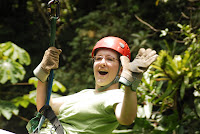
Probably the last thing that I need to say is something that I learned about myself toward the end of our time together in Costa Rica. I have always said during my travels around the world that I will always try anything once (except for fried termites--a girl has to draw the line somewhere!). Well, towards the end of our time in Costa Rica, that mantra was severely tested. On our last full day in Costa Rica we went out into the jungle to participate in a canopy safari (You can visit Canopy Safari's website here). For those of you who don't know what a canopy safari is, let me explain it to you. You are attached to a harness, and you literally hang in this harness from a carabiner that is attached to a cable suspended between trees, high up in the air (otherwise known as a zip-line). But, you are not just attached to the cable--you actually move through the air between the trees by "zipping" along this zip-line. It is cool in the fact that you get to see the canopy from within the canopy. It is NOT cool in the fact that you are flying through mid-air 150 feet up (or some such crazy height) with nothing holding you up except this cable, harness, and carabiner. Like this:
 And this:
I have to tell you, I was scared to death to do this! We were all told that we didn't have to do it, but that the entire group would be participating and that we would regret it and disappoint everyone else if we didn't do it. As a leader on this trip, I really felt like I had to. I was one of the people setting an example for the rest of the group. But, I really didn't want to, and I was scared! It even made me cry. However, one of the young people in my group, Holly, really encouraged me and I was able to overcome my fear and participate in this experience (but not without some swearing on my part). After having processed the day, I would probably even say that I had fun (something I was not willing to say immediately after the tour was over and I took off my harness and kissed the earth). I might even be willing to do it again someday. That is definitely growth for me.
My overall experience that day was awesome--I learned that I could do something I really thought I couldn't. I swear I thought I might die, but I came out OK in the end. It wasn't that bad and was actually kind of fun. And Holly really ministered to me and gave me the courage to do it. I wonder if she knows how important and powerful that was?
I also owe a lot to Big Al:

He seemed like a rough guy (he was telling jokes about some guy's "woody" on the way to the safari site) but really helped me be brave and didn't mess around because he knew I was scared. All in all, the staff at Canopy Safari was awesome. They took good care of us, and made sure we had a safe, positive, and fun experience.
The Canopy Safari was a good cap to an awesome week. I am proud of our youth for being such awesome young people--they did great work with the Costa Rican children, and ministered to me and to each other, too. I can only hope that I made a similar impression on them. During our time in Costa Rica, we all discovered more fully what it is like to live in God's Promise, as Children of God.

(Scroll down to read parts 1-3)

This is my last blog about my trip to Costa Rica with the synod at the beginning of August. I have been thinking a lot about Costa Rica the last few days. When I came home I went right back to work and really didn't get much time to process the trip. Now that it is the holiday weekend and I have had some time to myself away from the busy-ness of work, some things are clearer to me than they were immediately following my return.
First of all, I should make it clear that I had a really good time. I definitely had issues with the mission theology and teaching methods of Pura Vida Missions, but that doesn't take away from the fact that we were there to love and serve Costa Rican children, and we did that successfully and with great passion. In many ways the theology of Pura Vida Missions doesn't even matter, because those children (and our youth) had a great time and learned a lot about God's love for them through our service. The Holy Spirit was there, and she was working! A wise missionary once said to me, "The Holy Spirit doesn't work because of us, the Holy Spirit works in spite of us." Even though I heartily disagree with the theology of evangelism that Pura Vida practices, that doesn't mean that the Holy Spirit was absent. God can do great things, even in the midst of us sometimes doing not-so-great things.
Secondly, I feel really blessed to have been able to be a part of the lives of such wonderful, interesting youth. The young people who went on this journey with me are all intelligent, interesting people with futures full of hope. Some of them really touched my life, and that makes me feel very blessed. It was neat to see these young people blossom as they discovered a culture different from their own. Some of them really came out of their shells--they were discovering new things about themselves, too! Others revealed that there are things in their lives that they are really struggling with right now. Throwing people who don't know each other together like that in a different cultural environment can lead to wonderful realizations about ourselves and each other.
In particular, today I am thinking a lot about Jenn, Holly, and Candice. Each of them had their own very personal experiences, struggles, and revelations on this trip, and each of them taught me something about myself. There are others, too, who I have not named. I hope that they all continue to grow into the fabulous, enlightened young adults they are becoming.
Probably the last thing that I need to say is something that I learned about myself toward the end of our time together in Costa Rica. I have always said during my travels around the world that I will always try anything once (except for fried termites--a girl has to draw the line somewhere!). Well, towards the end of our time in Costa Rica, that mantra was severely tested. On our last full day in Costa Rica we went out into the jungle to participate in a canopy safari (You can visit Canopy Safari's website here). For those of you who don't know what a canopy safari is, let me explain it to you. You are attached to a harness, and you literally hang in this harness from a carabiner that is attached to a cable suspended between trees, high up in the air (otherwise known as a zip-line). But, you are not just attached to the cable--you actually move through the air between the trees by "zipping" along this zip-line. It is cool in the fact that you get to see the canopy from within the canopy. It is NOT cool in the fact that you are flying through mid-air 150 feet up (or some such crazy height) with nothing holding you up except this cable, harness, and carabiner. Like this:
 And this:
I have to tell you, I was scared to death to do this! We were all told that we didn't have to do it, but that the entire group would be participating and that we would regret it and disappoint everyone else if we didn't do it. As a leader on this trip, I really felt like I had to. I was one of the people setting an example for the rest of the group. But, I really didn't want to, and I was scared! It even made me cry. However, one of the young people in my group, Holly, really encouraged me and I was able to overcome my fear and participate in this experience (but not without some swearing on my part). After having processed the day, I would probably even say that I had fun (something I was not willing to say immediately after the tour was over and I took off my harness and kissed the earth). I might even be willing to do it again someday. That is definitely growth for me.
My overall experience that day was awesome--I learned that I could do something I really thought I couldn't. I swear I thought I might die, but I came out OK in the end. It wasn't that bad and was actually kind of fun. And Holly really ministered to me and gave me the courage to do it. I wonder if she knows how important and powerful that was?
I also owe a lot to Big Al:

He seemed like a rough guy (he was telling jokes about some guy's "woody" on the way to the safari site) but really helped me be brave and didn't mess around because he knew I was scared. All in all, the staff at Canopy Safari was awesome. They took good care of us, and made sure we had a safe, positive, and fun experience.
The Canopy Safari was a good cap to an awesome week. I am proud of our youth for being such awesome young people--they did great work with the Costa Rican children, and ministered to me and to each other, too. I can only hope that I made a similar impression on them. During our time in Costa Rica, we all discovered more fully what it is like to live in God's Promise, as Children of God.

Friday, August 24, 2007
Pura Vida: "Pure Life" in Costa Rica
Part 3
(Scroll down to read parts 1 & 2)

Morning
Thursday, August 9, 2007
There's this dog that lives next door to the mission that looks like the Budweiser dog. Brown and white with that flat face and pointy ears. He has his own dog house in the back corner of the yard and barks and wags his tail (mixed signals) when someone comes by.
Costa Rica is beautiful and tropical and lovely. The children are wide-eyed and eager to play, learn, and love. Our youth shared last night during debriefing how much the children have touched their hearts. The work is hard but fun and the mission of God and of God's church is so clearly happening here. I praise God that God is showing these youth what it means to be a Christian in mission in this world.
The other side of that for me (and for some of the youth and other adults who are alert) is the negative experience we have had with the staff. For me, a lot of it comes down to mission theology. Mission theology and Christian education are at the core of my personal identity, and this week I have felt trampled upon. There is a caution of care that seems to be lacking here. Why are these people really here? Some of our youth and adult leaders have said they think it could be for selfish reasons. Plus the fact that this is an American-run mission and that the Costa Ricans working here are the ones doing the grunt-work ("hired hands," almost) turns me off. The motivation and the model that I see being presented is very "us/them." An "Oh, let's pity these poor Costa Ricans" kind of mentality.
I am afraid of what this way of doing things is showing our youth. I hope they know better, or will at least process this week and eventually come to know better. I know that I and our other trip leaders have tried to be intentional in letting them know that there is another way to do mission--a way that is non-threatening, love-filled, and good. I really pray that God works in their lives to show them the true meaning of Christian living, service, and mission. I really pray that this week will positively affect their outlook and beliefs. I know some of them are struggling with some of these things already. I know that God is with all of them, and I pray that God works on their hearts for good.

Morning
Friday, August 10, 2007
Last night I stood in the rain at a public telephone outside a house store up the street and called my husband. I have been trying to reach him all week! It was good to hear his voice, but we didn't have much time to talk. It wasn't the place for serious conversation. It was mostly formalities, but it was still good to talk to him.
Today is the last day at the mission. At noon we will get on the bus and drive three hours to the Pacific Ocean. I am thankful to be able to leave this place and spend a few days relaxing and unwinding. It will be nice to sleep in a hotel, have nicer facilities, relax on the beach, go shopping, etc. We are also going on a canopy tour in the morning, which I am a little freaked out about but I hope will be really cool.
Yesterday I felt like the staff finally got us. This has been a rough week with them, but yesterday things finally seemed OK. Maybe they are as excited as we are to be coming to the end of their journey. We are their last group, and most of them will be returning to the U.S. this weekend.
I think last night was really hard for the youth. There was a lot of sharing and crying. It will be hard, and yet good, to go home. A lot of these young people are really struggling with a lot of things--not just about this experience, but about life. I hope they can leave this place with a different, helpful perspective.

Early Evening
Saturday, August 11, 2007
We travelled four hours by bus yesterday across Costa Rica to Manuel Antonio, a small beach resort town on the Pacific Ocean. It was interesting watching the countryside change from densely-populated Costa Rican mountain towns to miles of land filled with cows and grass where few people seemed to live, to mountainous coastal villages filled with resorts, condominiums, and Americans. In some ways, we could almost be in America in Manuel Antonio. Costa Ricans here are more like the hired help than the native population. In this part of Costa Rica, the U.S. Dollar and the white man rule.
It is still tropical and beautiful here. There is a sign on the bathroom wall warning us of a water shortage and reminding us that Costa Rica, in all its beauty, is still a Third World country. Is it? Things here are a lot better in a lot of ways than in Africa. I have been impressed by the many conveniences here--I have yet to have to pee in a hole in the ground! When I look around, I don't see Third World. I see people with many of the modern conveniences we have in America--cars, running water, electricity, good infrastructure. Costa Rica is somewhere between Africa and the U.S. in that regard. Maybe Second World?
Tourism is the biggest industry in Costa Rica, and in this part of the country it is definitely obvious. It is a shame that tourists (mostly Americans, I gather) are creating a new kind of "tourist colonialism" here. The dollar and American wants and needs seem to be taking over. At what cost? At whose expense? What is being lost? Is it really worth it? Does anybody other than me ever think about these things? What makes me the saddest is that most of the Americans (and other tourists) that come here don't seem to think about these things. They just want to spend their money and enjoy themselves, and they want the Costa Ricans to help them do it.
On the other hand, I am sure that it is tourist dollars that are making Costa Rica the well-developed nation that it is becoming. Is the loss worth the gain? Is that a fair trade-off?
Today we went on a canopy tour, which was really stressful for me! We basically "swung through the air with the greatest of ease" on zip-lines suspended between the trees high up in the canopy. Not exactly my cup of tea!

(Scroll down to read parts 1 & 2)

Morning
Thursday, August 9, 2007
There's this dog that lives next door to the mission that looks like the Budweiser dog. Brown and white with that flat face and pointy ears. He has his own dog house in the back corner of the yard and barks and wags his tail (mixed signals) when someone comes by.
Costa Rica is beautiful and tropical and lovely. The children are wide-eyed and eager to play, learn, and love. Our youth shared last night during debriefing how much the children have touched their hearts. The work is hard but fun and the mission of God and of God's church is so clearly happening here. I praise God that God is showing these youth what it means to be a Christian in mission in this world.
The other side of that for me (and for some of the youth and other adults who are alert) is the negative experience we have had with the staff. For me, a lot of it comes down to mission theology. Mission theology and Christian education are at the core of my personal identity, and this week I have felt trampled upon. There is a caution of care that seems to be lacking here. Why are these people really here? Some of our youth and adult leaders have said they think it could be for selfish reasons. Plus the fact that this is an American-run mission and that the Costa Ricans working here are the ones doing the grunt-work ("hired hands," almost) turns me off. The motivation and the model that I see being presented is very "us/them." An "Oh, let's pity these poor Costa Ricans" kind of mentality.
I am afraid of what this way of doing things is showing our youth. I hope they know better, or will at least process this week and eventually come to know better. I know that I and our other trip leaders have tried to be intentional in letting them know that there is another way to do mission--a way that is non-threatening, love-filled, and good. I really pray that God works in their lives to show them the true meaning of Christian living, service, and mission. I really pray that this week will positively affect their outlook and beliefs. I know some of them are struggling with some of these things already. I know that God is with all of them, and I pray that God works on their hearts for good.

Morning
Friday, August 10, 2007
Last night I stood in the rain at a public telephone outside a house store up the street and called my husband. I have been trying to reach him all week! It was good to hear his voice, but we didn't have much time to talk. It wasn't the place for serious conversation. It was mostly formalities, but it was still good to talk to him.
Today is the last day at the mission. At noon we will get on the bus and drive three hours to the Pacific Ocean. I am thankful to be able to leave this place and spend a few days relaxing and unwinding. It will be nice to sleep in a hotel, have nicer facilities, relax on the beach, go shopping, etc. We are also going on a canopy tour in the morning, which I am a little freaked out about but I hope will be really cool.
Yesterday I felt like the staff finally got us. This has been a rough week with them, but yesterday things finally seemed OK. Maybe they are as excited as we are to be coming to the end of their journey. We are their last group, and most of them will be returning to the U.S. this weekend.
I think last night was really hard for the youth. There was a lot of sharing and crying. It will be hard, and yet good, to go home. A lot of these young people are really struggling with a lot of things--not just about this experience, but about life. I hope they can leave this place with a different, helpful perspective.

Early Evening
Saturday, August 11, 2007
We travelled four hours by bus yesterday across Costa Rica to Manuel Antonio, a small beach resort town on the Pacific Ocean. It was interesting watching the countryside change from densely-populated Costa Rican mountain towns to miles of land filled with cows and grass where few people seemed to live, to mountainous coastal villages filled with resorts, condominiums, and Americans. In some ways, we could almost be in America in Manuel Antonio. Costa Ricans here are more like the hired help than the native population. In this part of Costa Rica, the U.S. Dollar and the white man rule.
It is still tropical and beautiful here. There is a sign on the bathroom wall warning us of a water shortage and reminding us that Costa Rica, in all its beauty, is still a Third World country. Is it? Things here are a lot better in a lot of ways than in Africa. I have been impressed by the many conveniences here--I have yet to have to pee in a hole in the ground! When I look around, I don't see Third World. I see people with many of the modern conveniences we have in America--cars, running water, electricity, good infrastructure. Costa Rica is somewhere between Africa and the U.S. in that regard. Maybe Second World?
Tourism is the biggest industry in Costa Rica, and in this part of the country it is definitely obvious. It is a shame that tourists (mostly Americans, I gather) are creating a new kind of "tourist colonialism" here. The dollar and American wants and needs seem to be taking over. At what cost? At whose expense? What is being lost? Is it really worth it? Does anybody other than me ever think about these things? What makes me the saddest is that most of the Americans (and other tourists) that come here don't seem to think about these things. They just want to spend their money and enjoy themselves, and they want the Costa Ricans to help them do it.
On the other hand, I am sure that it is tourist dollars that are making Costa Rica the well-developed nation that it is becoming. Is the loss worth the gain? Is that a fair trade-off?
Today we went on a canopy tour, which was really stressful for me! We basically "swung through the air with the greatest of ease" on zip-lines suspended between the trees high up in the canopy. Not exactly my cup of tea!

Tuesday, August 21, 2007
Pura Vida: "Pure Life" in Costa Rica
Part 2
(Scroll down to read Part 1)
I should probably be working on this weekend's sermon instead of writing a blog (Yes, I am preaching this weekend. Those of you in the Lansdale area who are interested should join me at church this weekend. Click here for our worship times). But, here I am, thinking again about Costa Rica and what I can possibly say to make this experience as real for you as it was for me.
Before you continue reading, I think this blog may need a DISCLAIMER: I really struggled with whether or not I should publish some of the doubts and frustrations I had during my time in Costa Rica. I was torn between trying to be positive for the sake of the youth and my other travelling companions, and being honest about my experience. Let me be clear: my experience with the people of Costa Rica was outstanding. I am so glad that I got to be a part of their lives--they have touched mine forever. My experience with the staff of Pura Vida Missions upset me greatly, however. I struggle with trying to adequately explain those frustrations and disappointments without upsetting anyone who might have had a different experience. Some of my journal entries have been edited in an attempt to be honest without being offensive.
I figure this is my blog, and I want people to know that I am real. I am real Christian person with hopes and dreams and frustrations and challenges just like everybody else.
Here are some excerpts from my journal:

Afternoon
Sunday, August 5, 2007
It was interesting driving through the Costa Rican countryside and watching the reactions of our youth and young adults. Many of them have never been outside the U.S., or if they have, it was to Canada or Europe or some other place more... what? Modern? Easy? Comfortable? I looked over the shoulder of one of our girls as she was writing in her journal... "This place is so beautiful...."
Some things about Costa Rica seem so familiar to me, even though I've never been here before. Banana trees. Afternoon rainy-season thunderstorms. Cold showers.
I also recognize a few big differences. I never wanted to come here. I mean, I wanted to come here--it's not like they duct-taped me to my airplane seat and made me come. But even as I travelled to Africa for the first time, I knew somehow that it was where I belonged. I was waiting to be proven wrong. I wondered as we rode the bus to the Dulles Airport to fly to Amsterdam and then to Tanzania how I could possibly know. But, I did. And, I was right. I was never proven wrong.
Yesterday evening, however, as we drove to New York City and JFK Airport, I was waiting for something else. That feeling--that mysterious, magical sure-ness was missing. Instead, I was waiting to be shown that this place could be loved, too.
Now that I am here, I am sure that it can be loved. But it will never have the hold on me that Africa does. Costa Rica is the closest I have come to an environment and a culture anywhere similar to Africa's in four LONG years, and I know already this experience will not be the same. Africa has this enchanted hold on me like nothing else, nowhere else, ever can.
It is starting to rain. I am looking forward to meeting the children tomorrow.

Morning
Monday, August 6, 2007
It's a beautiful tropical morning. I had fresh local pineapple and bananas for breakfast. The sun is starting to peek through the remnants of last night's rain storms.
I had an interesting conversation with ____ last night about our hopes and fears for the youth on this trip. My personal beliefs about the mission of the church and what it means to be a "missionary" have already been challenged in the 24 hours we have been here. I think the staff at Pura Vida expects us to live out a different mission theology than the one I believe to be right and good. What I can say is that I am not here to "save the souls" of the children we will meet. God will take care of that. I am here to show the love of Christ to them through service to and relationship with them. We are not here to proselytise. We are not here to give "testimonies." We are here to serve, and through our service show the love of Christ to these children.
Pressure has also already been put on our youth to have some sort of "salvific" experience while they are here--that God will "transform their lives." That may happen for many of them. But, it also may not. Even those with the most open hearts may not feel God move or hear God speak or even witness God working. Sometimes our ways are not God's ways. We can't force a transformation in the children we are here to serve, and we can't force it on ourselves. We can't assume we know when or where it will happen.
My earnest prayer for all of us this week--the children we are serving, and our own youth, young adults, and adults--is that God does what God needs and wants to do in each of our lives, whatever that may be. God is here--for some reason I always see that more clearly when I am somewhere else. God will work. In God's way, in God's time.

Morning
Tuesday, August 7, 2007
It is a beautiful Costa Rican morning. The sky is brilliantly blue, the sun is shining, and there are a few white, puffy, cottony clouds drifting by.
Yesterday after our service to the children we went into San Ramon to do some shopping, etc. I am surprised at the size of the town, the number of cars on the roads, the quality of the roads, and other things. There are public trash cans and people work hard to keep their town clean. There are functioning public telephones. There is electricity and clean water. There is free public education. This seems, in many ways, to be a nice place to live and to be from.
The children we are working with are awesome. They are eager to play and to love you and to be loved. They show God's love and light to us--even though that's what we are here to show them! They are full of joy and love and light. I know that these children are going to have a lasting effect on our youth.
The staff at Pura Vida has talked a lot since our arrival about "personal testimonies." This speaks again to the difficulties I am having in dealing with the mission theology of Pura Vida Missions. I want our youth to understand that the love and service that they are showing these Costa Rican children witnesses to the love of Christ for them more than any "personal testimony" ever could. Their service is a testimony.

(Scroll down to read Part 1)
I should probably be working on this weekend's sermon instead of writing a blog (Yes, I am preaching this weekend. Those of you in the Lansdale area who are interested should join me at church this weekend. Click here for our worship times). But, here I am, thinking again about Costa Rica and what I can possibly say to make this experience as real for you as it was for me.
Before you continue reading, I think this blog may need a DISCLAIMER: I really struggled with whether or not I should publish some of the doubts and frustrations I had during my time in Costa Rica. I was torn between trying to be positive for the sake of the youth and my other travelling companions, and being honest about my experience. Let me be clear: my experience with the people of Costa Rica was outstanding. I am so glad that I got to be a part of their lives--they have touched mine forever. My experience with the staff of Pura Vida Missions upset me greatly, however. I struggle with trying to adequately explain those frustrations and disappointments without upsetting anyone who might have had a different experience. Some of my journal entries have been edited in an attempt to be honest without being offensive.
I figure this is my blog, and I want people to know that I am real. I am real Christian person with hopes and dreams and frustrations and challenges just like everybody else.
Here are some excerpts from my journal:

Afternoon
Sunday, August 5, 2007
It was interesting driving through the Costa Rican countryside and watching the reactions of our youth and young adults. Many of them have never been outside the U.S., or if they have, it was to Canada or Europe or some other place more... what? Modern? Easy? Comfortable? I looked over the shoulder of one of our girls as she was writing in her journal... "This place is so beautiful...."
Some things about Costa Rica seem so familiar to me, even though I've never been here before. Banana trees. Afternoon rainy-season thunderstorms. Cold showers.
I also recognize a few big differences. I never wanted to come here. I mean, I wanted to come here--it's not like they duct-taped me to my airplane seat and made me come. But even as I travelled to Africa for the first time, I knew somehow that it was where I belonged. I was waiting to be proven wrong. I wondered as we rode the bus to the Dulles Airport to fly to Amsterdam and then to Tanzania how I could possibly know. But, I did. And, I was right. I was never proven wrong.
Yesterday evening, however, as we drove to New York City and JFK Airport, I was waiting for something else. That feeling--that mysterious, magical sure-ness was missing. Instead, I was waiting to be shown that this place could be loved, too.
Now that I am here, I am sure that it can be loved. But it will never have the hold on me that Africa does. Costa Rica is the closest I have come to an environment and a culture anywhere similar to Africa's in four LONG years, and I know already this experience will not be the same. Africa has this enchanted hold on me like nothing else, nowhere else, ever can.
It is starting to rain. I am looking forward to meeting the children tomorrow.

Morning
Monday, August 6, 2007
It's a beautiful tropical morning. I had fresh local pineapple and bananas for breakfast. The sun is starting to peek through the remnants of last night's rain storms.
I had an interesting conversation with ____ last night about our hopes and fears for the youth on this trip. My personal beliefs about the mission of the church and what it means to be a "missionary" have already been challenged in the 24 hours we have been here. I think the staff at Pura Vida expects us to live out a different mission theology than the one I believe to be right and good. What I can say is that I am not here to "save the souls" of the children we will meet. God will take care of that. I am here to show the love of Christ to them through service to and relationship with them. We are not here to proselytise. We are not here to give "testimonies." We are here to serve, and through our service show the love of Christ to these children.
Pressure has also already been put on our youth to have some sort of "salvific" experience while they are here--that God will "transform their lives." That may happen for many of them. But, it also may not. Even those with the most open hearts may not feel God move or hear God speak or even witness God working. Sometimes our ways are not God's ways. We can't force a transformation in the children we are here to serve, and we can't force it on ourselves. We can't assume we know when or where it will happen.
My earnest prayer for all of us this week--the children we are serving, and our own youth, young adults, and adults--is that God does what God needs and wants to do in each of our lives, whatever that may be. God is here--for some reason I always see that more clearly when I am somewhere else. God will work. In God's way, in God's time.

Morning
Tuesday, August 7, 2007
It is a beautiful Costa Rican morning. The sky is brilliantly blue, the sun is shining, and there are a few white, puffy, cottony clouds drifting by.
Yesterday after our service to the children we went into San Ramon to do some shopping, etc. I am surprised at the size of the town, the number of cars on the roads, the quality of the roads, and other things. There are public trash cans and people work hard to keep their town clean. There are functioning public telephones. There is electricity and clean water. There is free public education. This seems, in many ways, to be a nice place to live and to be from.
The children we are working with are awesome. They are eager to play and to love you and to be loved. They show God's love and light to us--even though that's what we are here to show them! They are full of joy and love and light. I know that these children are going to have a lasting effect on our youth.
The staff at Pura Vida has talked a lot since our arrival about "personal testimonies." This speaks again to the difficulties I am having in dealing with the mission theology of Pura Vida Missions. I want our youth to understand that the love and service that they are showing these Costa Rican children witnesses to the love of Christ for them more than any "personal testimony" ever could. Their service is a testimony.

Sunday, August 19, 2007
Pura Vida: "Pure Life" in Costa Rica
Part 1

I just spent 8 wonderful days in Costa Rica learning what it means to live "Pura Vida:" pure life. Costa Ricans basically live by this saying, and as you travel the countryside in Costa Rica you see the slogan everywhere.
I was in Costa Rica with 27 youth, young adults, and adults from the Southeastern Pennsylvania (SEPA) Synod of the Evangelical Lutheran Church in America (ELCA). We travelled to Costa Rica to serve in Christ's name and to be witnesses to others about the great love that Jesus has for people all over the world. In the process, we learned a lot about each other, the people of Costa Rica, and the amazing ways that God works in our lives. While we were in Costa Rica we served with an organization called Pura Vida Missions. We taught Vacation Bible School to children through games, drama, crafts, and Bible stories.
You should understand that the 27 people from SEPA Synod who travelled together to Costa Rica last week didn't really know each other that well prior to getting on that plane at JFK. We had done some group-building and prep work prior to the trip, but as a synod-wide group, we represented 16 different Lutheran congregations from the Philadelphia area. So, while some people had friends on the trip, others didn't know anybody. This experience was not just a chance to teach Vacation Bible School to Costa Rican children, it was also a chance for an unlikely group of 27 Americans to be thrown together to work, live, and serve others. Kind of sounds like an MTV reality show, doesn't it?
As I am writing this blog, I am trying to figure out exactly what I can say to summarize the experiences we all shared in Costa Rica. A lot of the young people that I travelled with had never been outside of the U.S. before, or if they had, it had been to somewhere where the standard of living is similar to that of the U.S. I think the things that surprised the youth most were things such as cold showers (!), or lack of water, or children coming to VBS in bare feet. It was interesting and inspiring to see these young people grapple with the challenges of understanding life in a different part of the world. I am sure that now, a week after our return, they are still struggling with the ways in which this trip has changed the way they look at the world.
I remember the first time I went to Africa. I spent two weeks in Tanzania with a group from College Lutheran Church in Salem, Virginia. I came home and my whole vision of life and love and what it means to be human had changed... and it was as though I was the only one on the planet who knew it or who even cared. I would see people walk up the sidewalk in my college town talking on their cell phones, or watch people drive by in their cars, radios blaring, and all of a sudden it all seemed so inconsequential. It is pretty hard to explain to others unless they have experienced it, too. It is a hard lesson to learn when you begin to understand from experience that most people in the world do not have the luxuries that you do. That was both one of the hardest and most freeing summers of my entire life.
Now, I know from experience that Costa Rica is NO Tanzania--but I have a point of reference other than the U.S. from which to draw comparisons. For the youth and young adults (and even some of the adults, I gather) on my trip to Costa Rica, the hardships that life there presented seemed surprising and difficult to cope with. What I kept thinking was how fortunate the people in Costa Rica are to have running water, indoor plumbing, electricity (most of the time), and paved roads. Many people there drive cars. Costa Rica is a success story in many ways--the government, from what I understand, has worked hard to make sure that the people reap the financial benefits from its booming tourism industry. However, the standard of living is still lower than in the U.S., and our youth recognized that. I think they were really changed and challenged by that realization.
I am still processing this experience. As I try to do every time I travel, I kept a travel journal while I was in Costa Rica. I will share some of my thoughts from my journal in my next post.

I just spent 8 wonderful days in Costa Rica learning what it means to live "Pura Vida:" pure life. Costa Ricans basically live by this saying, and as you travel the countryside in Costa Rica you see the slogan everywhere.
I was in Costa Rica with 27 youth, young adults, and adults from the Southeastern Pennsylvania (SEPA) Synod of the Evangelical Lutheran Church in America (ELCA). We travelled to Costa Rica to serve in Christ's name and to be witnesses to others about the great love that Jesus has for people all over the world. In the process, we learned a lot about each other, the people of Costa Rica, and the amazing ways that God works in our lives. While we were in Costa Rica we served with an organization called Pura Vida Missions. We taught Vacation Bible School to children through games, drama, crafts, and Bible stories.
You should understand that the 27 people from SEPA Synod who travelled together to Costa Rica last week didn't really know each other that well prior to getting on that plane at JFK. We had done some group-building and prep work prior to the trip, but as a synod-wide group, we represented 16 different Lutheran congregations from the Philadelphia area. So, while some people had friends on the trip, others didn't know anybody. This experience was not just a chance to teach Vacation Bible School to Costa Rican children, it was also a chance for an unlikely group of 27 Americans to be thrown together to work, live, and serve others. Kind of sounds like an MTV reality show, doesn't it?
As I am writing this blog, I am trying to figure out exactly what I can say to summarize the experiences we all shared in Costa Rica. A lot of the young people that I travelled with had never been outside of the U.S. before, or if they had, it had been to somewhere where the standard of living is similar to that of the U.S. I think the things that surprised the youth most were things such as cold showers (!), or lack of water, or children coming to VBS in bare feet. It was interesting and inspiring to see these young people grapple with the challenges of understanding life in a different part of the world. I am sure that now, a week after our return, they are still struggling with the ways in which this trip has changed the way they look at the world.
I remember the first time I went to Africa. I spent two weeks in Tanzania with a group from College Lutheran Church in Salem, Virginia. I came home and my whole vision of life and love and what it means to be human had changed... and it was as though I was the only one on the planet who knew it or who even cared. I would see people walk up the sidewalk in my college town talking on their cell phones, or watch people drive by in their cars, radios blaring, and all of a sudden it all seemed so inconsequential. It is pretty hard to explain to others unless they have experienced it, too. It is a hard lesson to learn when you begin to understand from experience that most people in the world do not have the luxuries that you do. That was both one of the hardest and most freeing summers of my entire life.
Now, I know from experience that Costa Rica is NO Tanzania--but I have a point of reference other than the U.S. from which to draw comparisons. For the youth and young adults (and even some of the adults, I gather) on my trip to Costa Rica, the hardships that life there presented seemed surprising and difficult to cope with. What I kept thinking was how fortunate the people in Costa Rica are to have running water, indoor plumbing, electricity (most of the time), and paved roads. Many people there drive cars. Costa Rica is a success story in many ways--the government, from what I understand, has worked hard to make sure that the people reap the financial benefits from its booming tourism industry. However, the standard of living is still lower than in the U.S., and our youth recognized that. I think they were really changed and challenged by that realization.
I am still processing this experience. As I try to do every time I travel, I kept a travel journal while I was in Costa Rica. I will share some of my thoughts from my journal in my next post.
Saturday, August 4, 2007
Costa Rica or Bust
Costa Rica, here I come!
Tonight I am on my way to Costa Rica with twenty-seven youth, young adults, and adults from the Southeastern Pennsylvania Synod of the Lutheran Church (ELCA). We are going to teach at Campamento de Ninos with an organization called Pura Vida Missions. Pura Vida Missions is a Christian, non-denominational servant organization that seeks "to transform lives by providing Christ-centered, life-changing mission adventures." Campamento de Ninos is Pura Vida's version of what we Americans would call Vacation Bible School.
When we are done with our week of service, we will be headed to the Pacific Ocean for a few days of sight-seeing, relaxing, and "beaching." I probably won't have access to a computer until I return, but I promise to keep my journal and post a blog or two (and maybe some pictures!) when I get back.
Tonight I am on my way to Costa Rica with twenty-seven youth, young adults, and adults from the Southeastern Pennsylvania Synod of the Lutheran Church (ELCA). We are going to teach at Campamento de Ninos with an organization called Pura Vida Missions. Pura Vida Missions is a Christian, non-denominational servant organization that seeks "to transform lives by providing Christ-centered, life-changing mission adventures." Campamento de Ninos is Pura Vida's version of what we Americans would call Vacation Bible School.
When we are done with our week of service, we will be headed to the Pacific Ocean for a few days of sight-seeing, relaxing, and "beaching." I probably won't have access to a computer until I return, but I promise to keep my journal and post a blog or two (and maybe some pictures!) when I get back.
Sunday, June 24, 2007
Reflections from Appalachia: Part II
Or, From Charity to Justice
When thinking about the work that ASP is doing, I am proud that I was able to be a part of it. Given the opportunity, I would go again. I am sure that next year we will plan a similar trip, and hopefully even more young adults will participate than this year. It is good to be drawn out of your comfort zone and pushed into a different culture and socio-economic situation than the one you live in. Although the participants go to help the people of Appalachia, I believe that in many instances the ones serving learn more and are ministered to more than the ones being served. ASP helps teach youth, young adults, and adults who come to serve about the realities of life.
One of the frustrating things about ASP for me, however, is the challenge of moving beyond charity and towards justice. Fixing someone's trailer is nice and certainly makes her situation more comfortable, but it does little to solve the societal issues that make her as poor as she is. Don't get me wrong--the work that ASP is accomplishing is very important for the individuals whose lives they touch. However, even though a person's trailer may be warmer, safer, and drier, she is still poor and unemployed. It's similar to a soup kitchen--feeding the hungry is a wonderful thing to do. These people have an immediate need, which is to eat. However, they will just come back hungry again tomorrow unless you work to fix the bigger issue that is causing them to be hungry in the first place.
I don't claim to know everything about ASP's agenda in Appalachia, and as I have already stated, I do believe they are doing a wonderful ministry there. Some of the evenings we spent in Knox County were spent discussing the issues of poverty in the area, what we think about it, and what we think we could do about it. We were asked if we believed that the situation there is hopeless. We were taught about the history that brought poverty into that part of our country. We were taught about the rich heritage there. We were also taught the statistics--in some parts of Appalachia, including in Knox County where we were, unemployment can reach 20%. That means that 1 out of every 5 people is unemployed. At what point do we move beyond fixing people's homes and talking about the situation, and towards doing something to improve the root causes of the problem?
The manual that I received from ASP prior to going to Appalachia says on page 17 that "[ASP founder Tex Evans] created ASP not to solve the poverty issues in Appalachia but to change lives." I think there is something missing here. ASP does a wonderful job at building relationships and increasing the understanding of poverty in those who come to serve. ASP also does a fine job at changing individual families' lives by making their homes warmer, safer, and drier. But--what is happening to change the root cause of the problem?
I have to admit that I know full well that there are no easy answers. I believe we should be moving from charity (fixing peoples' trailers) and towards justice (solving the problem of poverty in Appalachia so that everyone's quality of life improves), but I do not know how to do that. Maybe if I had made my home in Appalachia in service to the local people, I might understand better how to do that. But, maybe not. I lived in Africa for two years in a place where most people support their families on less than $1.00 a day. After being there for two years, I still do not know what the solution is to their problems. I do have some ideas about how to help solve some of them. But, they have been made victims of governments and militias and so many other powers beyond their control. How do we go about changing history?
I do not believe that the situation in Appalachia is hopeless. But I also wonder what I can effectively do about it. Rollie Martinson, one of my professors in seminary once said to me (I'm paraphrasing here) that the size of the problem may be as big as a beach ball, and what you can do about it might be the size of a marble. But, at least you have done that much, and if everybody did a marble's worth, then many marbles would eventually fill the beach ball and eliminate the problem. Maybe that is what ASP is doing--slowly filling the beach ball with marbles, one run-down trailer at a time. In the process, they are educating people about the issues in Appalachia. Maybe one day that will lead to a solution. Maybe we are slowly moving that way now... so slowly, that I can not see it with my limited vision.
Historical, social, and economic factors in Appalachia have aligned themselves in a frustrating and seemingly endless cycle of poverty. We can not change the past. How do we move ahead into a future with hope?
When thinking about the work that ASP is doing, I am proud that I was able to be a part of it. Given the opportunity, I would go again. I am sure that next year we will plan a similar trip, and hopefully even more young adults will participate than this year. It is good to be drawn out of your comfort zone and pushed into a different culture and socio-economic situation than the one you live in. Although the participants go to help the people of Appalachia, I believe that in many instances the ones serving learn more and are ministered to more than the ones being served. ASP helps teach youth, young adults, and adults who come to serve about the realities of life.
One of the frustrating things about ASP for me, however, is the challenge of moving beyond charity and towards justice. Fixing someone's trailer is nice and certainly makes her situation more comfortable, but it does little to solve the societal issues that make her as poor as she is. Don't get me wrong--the work that ASP is accomplishing is very important for the individuals whose lives they touch. However, even though a person's trailer may be warmer, safer, and drier, she is still poor and unemployed. It's similar to a soup kitchen--feeding the hungry is a wonderful thing to do. These people have an immediate need, which is to eat. However, they will just come back hungry again tomorrow unless you work to fix the bigger issue that is causing them to be hungry in the first place.
I don't claim to know everything about ASP's agenda in Appalachia, and as I have already stated, I do believe they are doing a wonderful ministry there. Some of the evenings we spent in Knox County were spent discussing the issues of poverty in the area, what we think about it, and what we think we could do about it. We were asked if we believed that the situation there is hopeless. We were taught about the history that brought poverty into that part of our country. We were taught about the rich heritage there. We were also taught the statistics--in some parts of Appalachia, including in Knox County where we were, unemployment can reach 20%. That means that 1 out of every 5 people is unemployed. At what point do we move beyond fixing people's homes and talking about the situation, and towards doing something to improve the root causes of the problem?
The manual that I received from ASP prior to going to Appalachia says on page 17 that "[ASP founder Tex Evans] created ASP not to solve the poverty issues in Appalachia but to change lives." I think there is something missing here. ASP does a wonderful job at building relationships and increasing the understanding of poverty in those who come to serve. ASP also does a fine job at changing individual families' lives by making their homes warmer, safer, and drier. But--what is happening to change the root cause of the problem?
I have to admit that I know full well that there are no easy answers. I believe we should be moving from charity (fixing peoples' trailers) and towards justice (solving the problem of poverty in Appalachia so that everyone's quality of life improves), but I do not know how to do that. Maybe if I had made my home in Appalachia in service to the local people, I might understand better how to do that. But, maybe not. I lived in Africa for two years in a place where most people support their families on less than $1.00 a day. After being there for two years, I still do not know what the solution is to their problems. I do have some ideas about how to help solve some of them. But, they have been made victims of governments and militias and so many other powers beyond their control. How do we go about changing history?
I do not believe that the situation in Appalachia is hopeless. But I also wonder what I can effectively do about it. Rollie Martinson, one of my professors in seminary once said to me (I'm paraphrasing here) that the size of the problem may be as big as a beach ball, and what you can do about it might be the size of a marble. But, at least you have done that much, and if everybody did a marble's worth, then many marbles would eventually fill the beach ball and eliminate the problem. Maybe that is what ASP is doing--slowly filling the beach ball with marbles, one run-down trailer at a time. In the process, they are educating people about the issues in Appalachia. Maybe one day that will lead to a solution. Maybe we are slowly moving that way now... so slowly, that I can not see it with my limited vision.
Historical, social, and economic factors in Appalachia have aligned themselves in a frustrating and seemingly endless cycle of poverty. We can not change the past. How do we move ahead into a future with hope?
Sunday, June 17, 2007
Reflections from Appalachia: Part I
This is part one of at least two! Please stay tuned for the second piece. I will be on the road again this week, so I promise to write when I can!
I just spent a week in Knox County, Kentucky, in the heart of Appalachian Mountain coal country. I went with a group of adults and young adults from Trinity to serve with Appalachia Service Project, or ASP. ASP is an organization that helps make lower-income families' homes in Appalachia safer, warmer, and drier. You can visit their website at http://www.asphome.org/.
There is a lot of poverty in the Appalachian region of the U.S. One of the things that struck me during my time in Knox County was that we as affluent Americans always seem to think of poverty as an inner-city or a Third-World problem. My guess is that many people do not know about the extreme poverty that exists right in the heart of our country. There are not many opportunities for economic enrichment in Appalachia. The woman whose home we were repairing has lived in a trailer her entire life. When we asked her what she would do if she ever owned a home, she said she wouldn't know what to do with one. A run-down trailer is all she has ever known, and it is probably all she will ever know.
The woman on whose home we worked (I don't want to tell you her name for privacy's sake) makes about $600 per month from public assistance. She is unemployed and feeds her family (two sons and a daughter) and several animals with food stamps. The trailer was in complete disrepair, although it has a new roof and some new flooring because of work ASP did there last summer. We were there to replace the ceilings and insulation that have deteriorated because of previous water damage.
The work was hard, hot, and dirty. Six people in a small room in a tin trailer in June made for some sweaty and smelly work. Not to mention that bringing down rotted fiber-board ceiling and insulation also means wearing face-masks, goggles, long-sleeved shirts, and getting REALLY DIRTY! But the work was fulfilling as we saw the old insulation and ceiling come down, and the new insulation and ceiling go up, complete with new light fixtures and molding. It was nice to see the work taking shape, but even more magnificent was the look on our homeowner's face as she saw the rooms being transformed. It seemed like the little things, more than the big things, were what were most important for her. The new ceiling was great, but what she was really thrilled about were the new light fixtures, a newly-working ceiling-light switch in the bedroom, a no-longer-creaky floorboard, a fixed front screen-door spring, and a previously non-existent dryer vent in her bathroom.
I am still processing the importance of this experience for myself and for the homeowner who we got to know so well in such a short time. She has lived in Knox County her entire life, and has never been more than an hour from home. The fact that we came all the way from Pennsylvania just to help her was amazing to her. It also shows the contrast between our affluence and opportunity and hers. She will never have the chance to cross state lines to help someone else. One of the things that struck me is that in the town where we live, Pierre and I are not really considered well off at all. There are times when we really struggle to make ends meet. And yet, we have so much more than this woman, both materially and in terms of opportunity. It really puts things in perspective--maybe my problems aren't as bad as I think they are!
When I was in missionary orientation prior to moving to Africa, a man named Tony Gittins came and spoke to us about his missionary experience. He had spent 25+ years in Sierra Leone building houses, hospitals, and all kinds of buildings. After he left Sierra Leone, civil war broke out and all the buildings that he had worked so hard to build were destroyed. He said that people always asked him what he felt about the fact that everything he had built in Sierra Leone no longer existed. And he always replied that the work that he did that actually mattered wasn't building buildings--it was building relationships, and those couldn't be destroyed by war. What matters, he said, is the relationships you build, and the people you love, and the people who love you. THAT's what lasts, and that's what's important.
That's what I think ASP is about, too. Yes, making people's homes warmer, safer, and drier is an important and worthwhile task. However, the importance of the experience goes a long way beyond construction. We build relationships and minister to those families, and those families minister to us.
I just spent a week in Knox County, Kentucky, in the heart of Appalachian Mountain coal country. I went with a group of adults and young adults from Trinity to serve with Appalachia Service Project, or ASP. ASP is an organization that helps make lower-income families' homes in Appalachia safer, warmer, and drier. You can visit their website at http://www.asphome.org/.
There is a lot of poverty in the Appalachian region of the U.S. One of the things that struck me during my time in Knox County was that we as affluent Americans always seem to think of poverty as an inner-city or a Third-World problem. My guess is that many people do not know about the extreme poverty that exists right in the heart of our country. There are not many opportunities for economic enrichment in Appalachia. The woman whose home we were repairing has lived in a trailer her entire life. When we asked her what she would do if she ever owned a home, she said she wouldn't know what to do with one. A run-down trailer is all she has ever known, and it is probably all she will ever know.
The woman on whose home we worked (I don't want to tell you her name for privacy's sake) makes about $600 per month from public assistance. She is unemployed and feeds her family (two sons and a daughter) and several animals with food stamps. The trailer was in complete disrepair, although it has a new roof and some new flooring because of work ASP did there last summer. We were there to replace the ceilings and insulation that have deteriorated because of previous water damage.
The work was hard, hot, and dirty. Six people in a small room in a tin trailer in June made for some sweaty and smelly work. Not to mention that bringing down rotted fiber-board ceiling and insulation also means wearing face-masks, goggles, long-sleeved shirts, and getting REALLY DIRTY! But the work was fulfilling as we saw the old insulation and ceiling come down, and the new insulation and ceiling go up, complete with new light fixtures and molding. It was nice to see the work taking shape, but even more magnificent was the look on our homeowner's face as she saw the rooms being transformed. It seemed like the little things, more than the big things, were what were most important for her. The new ceiling was great, but what she was really thrilled about were the new light fixtures, a newly-working ceiling-light switch in the bedroom, a no-longer-creaky floorboard, a fixed front screen-door spring, and a previously non-existent dryer vent in her bathroom.
I am still processing the importance of this experience for myself and for the homeowner who we got to know so well in such a short time. She has lived in Knox County her entire life, and has never been more than an hour from home. The fact that we came all the way from Pennsylvania just to help her was amazing to her. It also shows the contrast between our affluence and opportunity and hers. She will never have the chance to cross state lines to help someone else. One of the things that struck me is that in the town where we live, Pierre and I are not really considered well off at all. There are times when we really struggle to make ends meet. And yet, we have so much more than this woman, both materially and in terms of opportunity. It really puts things in perspective--maybe my problems aren't as bad as I think they are!
When I was in missionary orientation prior to moving to Africa, a man named Tony Gittins came and spoke to us about his missionary experience. He had spent 25+ years in Sierra Leone building houses, hospitals, and all kinds of buildings. After he left Sierra Leone, civil war broke out and all the buildings that he had worked so hard to build were destroyed. He said that people always asked him what he felt about the fact that everything he had built in Sierra Leone no longer existed. And he always replied that the work that he did that actually mattered wasn't building buildings--it was building relationships, and those couldn't be destroyed by war. What matters, he said, is the relationships you build, and the people you love, and the people who love you. THAT's what lasts, and that's what's important.
That's what I think ASP is about, too. Yes, making people's homes warmer, safer, and drier is an important and worthwhile task. However, the importance of the experience goes a long way beyond construction. We build relationships and minister to those families, and those families minister to us.
Tuesday, April 24, 2007
Out of Africa (with apologies to Isak Dinesen)
One of the challenges that I have had since returning from Africa almost 5 years ago is adapting to the fact that it is really hard to believe that Africa and America can co-exist on the same planet. You may be thinking that I am just about to reaffirm all the bad things you may have heard about Africa. When people find out that I lived there, they often want to know about the war and violence I saw there, because that is all they know about it. That is all the media tells us. In this and in many other ways, we are victims of our media.
The truth is, I didn't see much violence in Cameroon, the country where I was living. I have seen and heard more about violence on the streets of Philadelphia since moving here than I ever did in Cameroon.
What I did see, and what I continue to think about, is a very distorted distribution of the world's food and economic resources. It is odd to me that Americans have a lot of money and things and are a part of a society that tells us that more is better. And yet, few of us are really happy. On the other hand, Cameroonians have very little in the way of material goods or money. Despite their problems with poverty, hunger, and corruption, many Cameroonians lead very happy lives. The simplicity of life almost seems to be a part of what makes them happy. I think that Americans can learn a lot from Africans in this regard.
We Americans spend a lot of money on stuff. Have you ever really thought about how much money you spend on things you really don't need? We have no problem dropping a couple hundred dollars on one item we think we really want or need. Yet, many Africans live on less than $250 dollars a year. That's less than $1 a day. And they have to take care of themselves and their families on that amount.
This year for Easter, my husband and I sent some money to a family we know in Cameroon so that they could have an Easter dinner. The mother of this family was also supposed to give 2,000FCFA (Central African Francs) of that money to each child in the house. 2,000FCFA is the equivalent of about 4 U.S. dollars. It was more money than some of these children had ever seen. We called the house after Easter and spoke with the children. In talking to one of the girls who is in middle school, I asked her what she did with the money. I, being an American, and having been out of Africa for some time now, have forgotten what life is like there. I expected her to say what any normal American child would have said--"I'm saving it," or "I bought ____ toy I've been wanting," or, "I bought new clothes," or... something. But do you know what she said??? She replied, "I ate." I said, "You ate?" and she said, "Yes."
2,000FCFA, the equivalent of 4 U.S. dollars, would buy breakfast for a little girl in Cameroon for almost 3 weeks. Most days, she probably goes without breakfast. She also probably goes without lunch. She will eat one meal a day, in the evenings before going to bed. Some days, she may not eat anything.
I spend more than 4 U.S. dollars on one meal when I eat fast food. That fast food meal probably contains more calories than many African children consume in 2-3 days.
Think about that! I am wondering what we can do as a society to fix this problem. I am also wondering what we need to be doing about it as Christians. We can not say it is not our problem--in fact, much of this problem has been caused by us and our capitalist system and colonialist ways. In addition, Jesus told us and modeled for us that as followers of Christ, it is our problem.
I am not saying that we need to feel bad about eating fast food every now and then. I am just wondering what our responsibility is and should be to these people. I am also asking that we think about the ways in which we spend money and how that literally "buys into" a very warped system and a much larger problem.
I am sad about this because I do not know how to change it. It is a problem that is bigger than you or me. It is a problem that "sending money" will not solve--when the money is gone, once that little girl has eaten her 3 weeks worth of breakfasts, the problem will still be there. What are we going to do?
The truth is, I didn't see much violence in Cameroon, the country where I was living. I have seen and heard more about violence on the streets of Philadelphia since moving here than I ever did in Cameroon.
What I did see, and what I continue to think about, is a very distorted distribution of the world's food and economic resources. It is odd to me that Americans have a lot of money and things and are a part of a society that tells us that more is better. And yet, few of us are really happy. On the other hand, Cameroonians have very little in the way of material goods or money. Despite their problems with poverty, hunger, and corruption, many Cameroonians lead very happy lives. The simplicity of life almost seems to be a part of what makes them happy. I think that Americans can learn a lot from Africans in this regard.
We Americans spend a lot of money on stuff. Have you ever really thought about how much money you spend on things you really don't need? We have no problem dropping a couple hundred dollars on one item we think we really want or need. Yet, many Africans live on less than $250 dollars a year. That's less than $1 a day. And they have to take care of themselves and their families on that amount.
This year for Easter, my husband and I sent some money to a family we know in Cameroon so that they could have an Easter dinner. The mother of this family was also supposed to give 2,000FCFA (Central African Francs) of that money to each child in the house. 2,000FCFA is the equivalent of about 4 U.S. dollars. It was more money than some of these children had ever seen. We called the house after Easter and spoke with the children. In talking to one of the girls who is in middle school, I asked her what she did with the money. I, being an American, and having been out of Africa for some time now, have forgotten what life is like there. I expected her to say what any normal American child would have said--"I'm saving it," or "I bought ____ toy I've been wanting," or, "I bought new clothes," or... something. But do you know what she said??? She replied, "I ate." I said, "You ate?" and she said, "Yes."
2,000FCFA, the equivalent of 4 U.S. dollars, would buy breakfast for a little girl in Cameroon for almost 3 weeks. Most days, she probably goes without breakfast. She also probably goes without lunch. She will eat one meal a day, in the evenings before going to bed. Some days, she may not eat anything.
I spend more than 4 U.S. dollars on one meal when I eat fast food. That fast food meal probably contains more calories than many African children consume in 2-3 days.
Think about that! I am wondering what we can do as a society to fix this problem. I am also wondering what we need to be doing about it as Christians. We can not say it is not our problem--in fact, much of this problem has been caused by us and our capitalist system and colonialist ways. In addition, Jesus told us and modeled for us that as followers of Christ, it is our problem.
I am not saying that we need to feel bad about eating fast food every now and then. I am just wondering what our responsibility is and should be to these people. I am also asking that we think about the ways in which we spend money and how that literally "buys into" a very warped system and a much larger problem.
I am sad about this because I do not know how to change it. It is a problem that is bigger than you or me. It is a problem that "sending money" will not solve--when the money is gone, once that little girl has eaten her 3 weeks worth of breakfasts, the problem will still be there. What are we going to do?
Subscribe to:
Posts (Atom)